
Big Ocean Project — Tilbury Riverside
Tilbury Riverside · United Kingdom · 2012
Technical data
- Client
- KDC London
- Floor area
- 12,350 m²
- Programme
- Heritage refurbishment and interpretation centre
- Year
- 2012
- Status
- Design
Description
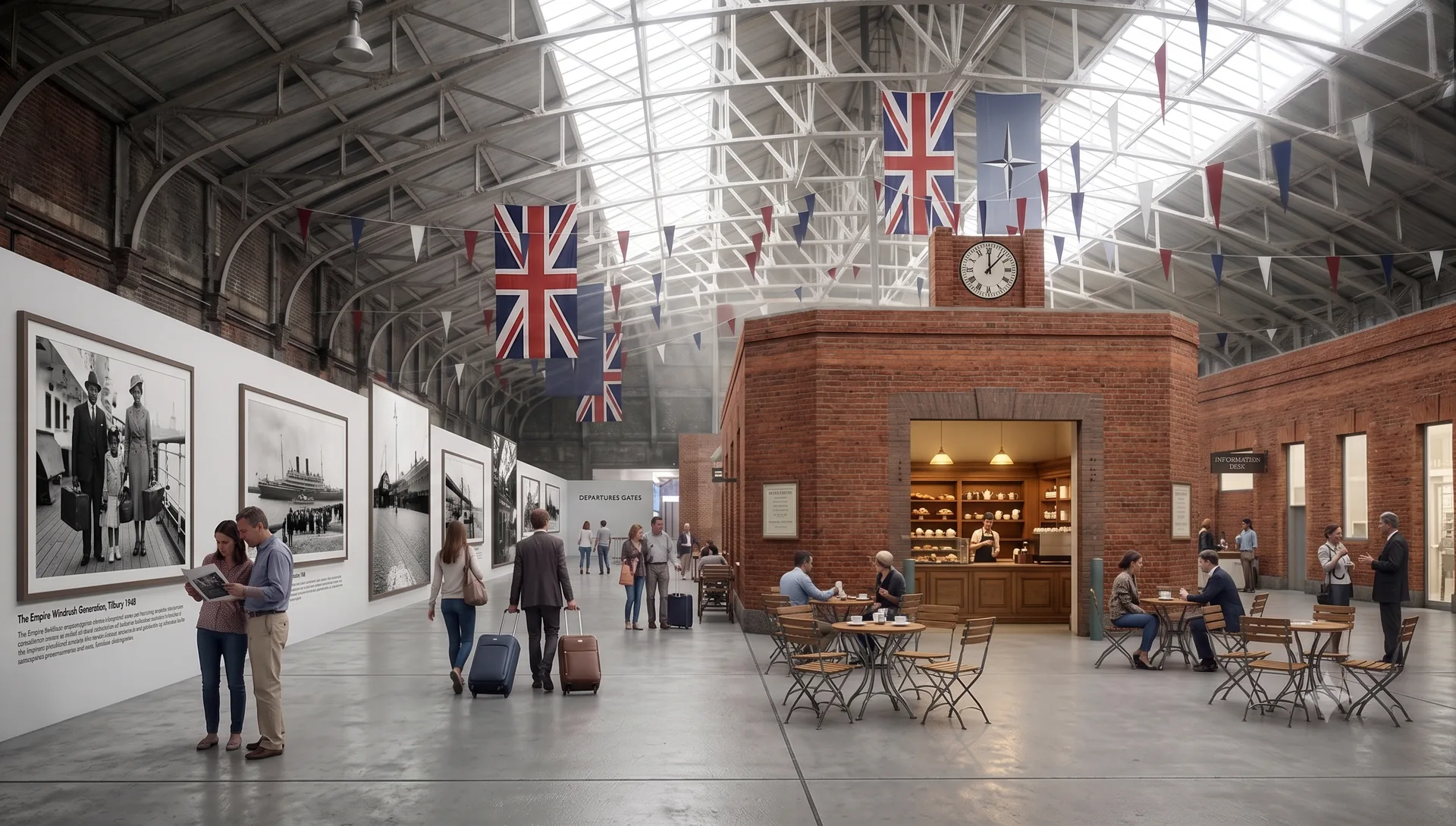
Big Ocean Project — Tilbury Riverside recovers one of the most significant port enclaves on the Thames estuary, next to the London Cruise Terminal. The intervention covers the former river station, the historic access gangways to the quay and the jetties, and addresses the restoration of the terminal not only as an architectural operation but as the recovery of a place of memory: for decades, Tilbury was a point of arrival and departure for travellers, immigrants, emigrants, workers, soldiers, artists, scientists, writers and public figures of British history.
The proposal is organised around several elements. Riverside Station is conceived as a great circulation and exhibition hall, recovering the presence of the former terminal through the restoration of floors, trusses, joinery and historic envelope. The former ticket office becomes once again a piece of information and welcome, and from it unfold a discovery centre, archive, classrooms, exhibition rooms and a Tribute Room: a quiet place of remembrance where family stories and migration narratives connect with the collective memory of the port.
One of the most relevant elements is the recovery of Windrush Brow, the historic gangway that connects the terminal with the jetty, interpreted as a narrative route where the visitor walks in the footsteps of those who arrived at or departed from Tilbury. The proposal incorporates a timeline of passengers and personalities associated with the place, among them Alan Turing, Alexander Fleming, Alexander Graham Bell, Charlie Chaplin, Ernest Shackleton, J. R. R. Tolkien, John Logie Baird, Mark Twain, Queen Victoria, Robert Falcon Scott, Robert Baden-Powell, Winston Churchill, T. E. Lawrence and William Booth, alongside other cultural, political, scientific and social references.
The restoration strategy is compatible with the new public uses: existing structures are cleaned, repaired and reinforced while preserving the historic reading, whereas the new additions —skylights, services, lighting, signage and museography— are approached with a sober, respectful criterion. From the interpretation centre, the visual relationship with the river and the river traffic is recovered, understanding the Thames as an essential part of the experience. The terminal ceases to be only a historic building and becomes an observatory of British maritime memory.
Gallery
Project in the design phase. Non-contractual image: virtual recreation produced with the assistance of artificial intelligence; the final result may vary.