River channel clearance and reshaping
l’Horta Sud · Spain · 2026
Technical data
- Type of work
- Channel clearance and bank protection with rock armour
- Scale
- 2.7 km stretch of channel
- Studio’s role
- Baseline studies, outline design and documentation for the permit and the environmental procedure
- Clearance
- ~78,000 m³ · 46 cm average layer · 54 design cross-sections
- Banks
- 1,750 m with rock armour · 8 solution types
- Year
- 2026
- Status
- Studies and outline design completed, permits in progress
Description
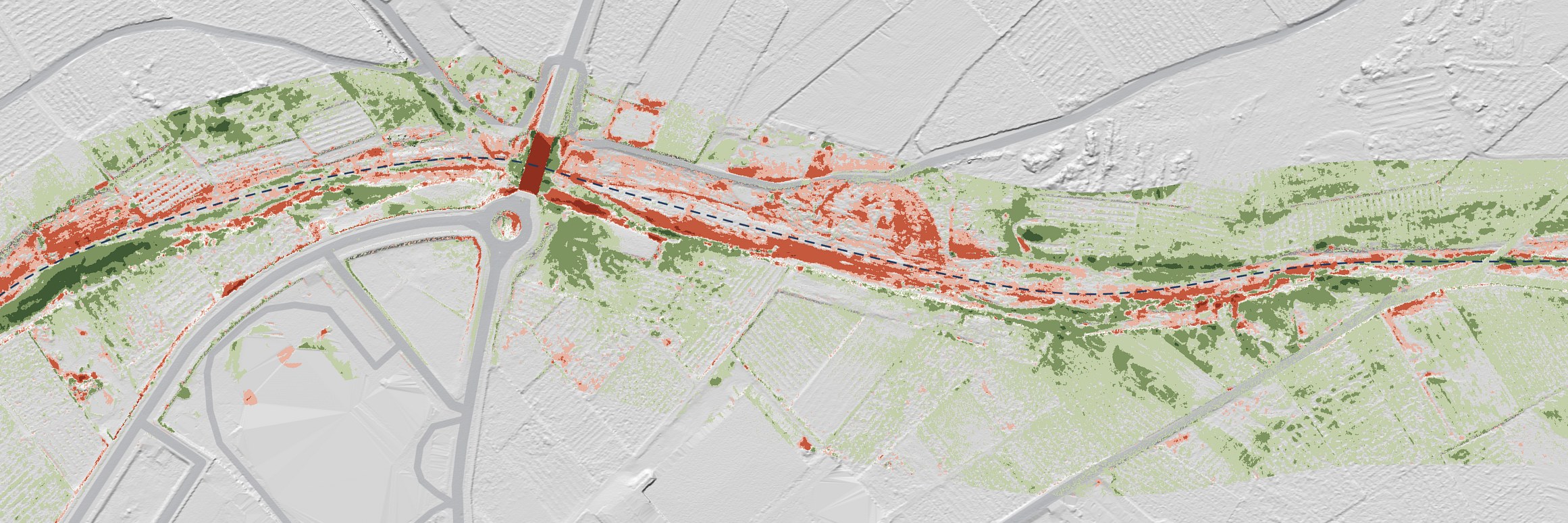
The October 2024 flood left a stretch of ravine silted up with sediment in its lower reach, scoured in its upper reach and with much of its banks stripped of protection. Comparing the topographic surveys before and after the event gives some 38,300 m³ eroded and some 47,700 m³ deposited. A silted-up channel drains less well, and an undermined bank is the first to give way in the next flood.
The studio started by measuring before proposing: it compared the surveys before and after the flood, to an accuracy of around 8 cm, and assessed the banks every 10 m. That measurement sets both the extent of each measure and the type of solution. For the clearance, the key decision was to restore the drainage gradient rather than the previous bed level: upstream, the channel was left wider, steeper and able to carry more water, and reinstating the old level would have created a bottleneck in front of it.
The clearance removes a layer averaging about 46 cm in thickness —some 78,000 m³ in total— along 2.7 km of channel, defined in 54 design cross-sections. The new bed starts from the inlet level left by the flood and follows the previous gradient, slightly gentler: it restores the discharge section that the flood silted up, without seeking new capacity. It involves removal only: there is no filling, natural pools are kept, the work stops at the toe of the banks, and some 3.7 ha of invasive giant reed that colonised the deposit are removed, rhizomes included.
The reshaping protects 1,750 m of bank, only where the assessment shows loss and with no isolated stretches shorter than 50 m. The rock armour is set into the regraded slope so as not to narrow the channel; it finishes at the current top level, without raising it, and its toe sits in a 1.5 m trench with a 2 m toe apron. Block size is matched to the damage: 1 to 3 t where scour was severe, and 300 to 1,000 kg, prepared for revegetation, where it was moderate. There are eight solution types in all, from consolidating existing protection to reshaping the slope in earth.
Gallery
Interpretive diagrams prepared by the studio, not to scale, and a detail of a cross-section from the outline designs.