Channel renaturalisation and bioengineering
l’Horta Sud · Spain · 2026–2028
Technical data
- Type of work
- Riverbank restoration and slope bioengineering
- Scale
- A stretch of watercourse, on the reshaped banks
- Studio’s role
- Outline design; joint environmental report for the channel works
- Banks
- ~570 m of rock armour ready for planting · 500 m of earth bank
- Scope
- 6 separable parts · 2 years of monitoring
- Year
- 2026–2028
- Status
- Outline design in progress · environmental application submitted
Description
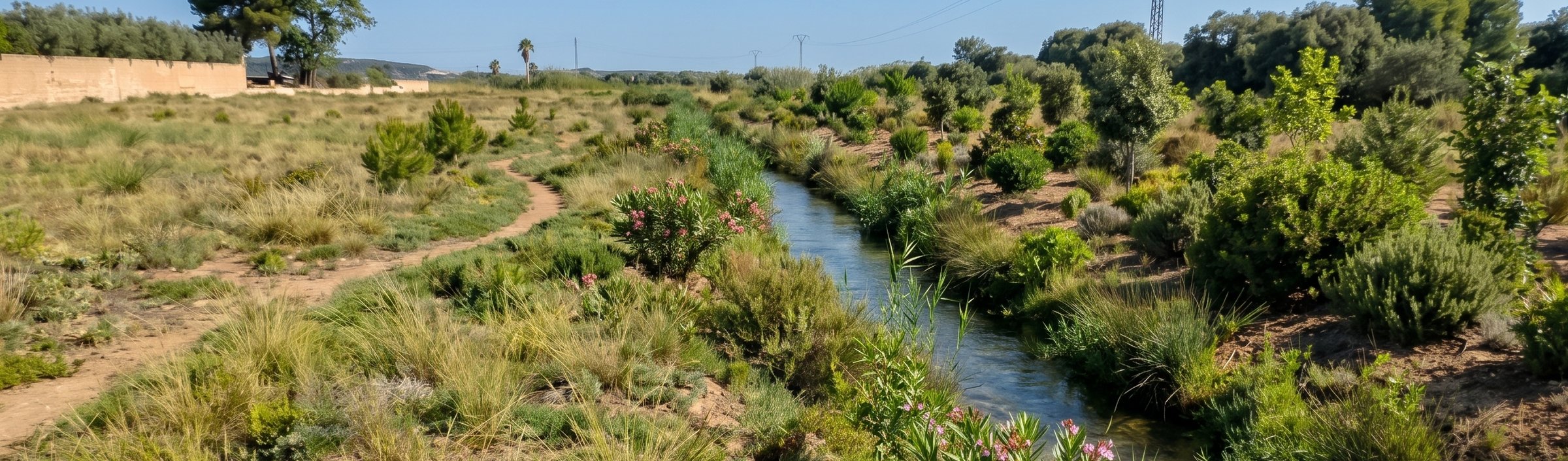
The October 2024 flood swept away the riparian vegetation along a stretch of watercourse and stripped its banks of the plant cover that held the soil in place. Giant reed, an invasive alien species that crowds out riparian vegetation, quickly spread over the sediment the flood left behind. Neither clearing the bed nor rock armour can restore the natural function of the riverbank on their own: it has to be restored so that the soil on the banks does not erode again and the watercourse recovers its habitat.
The studio approaches renaturalisation as the third piece of a single sequence, after clearing the bed and reshaping the banks. The guiding principle is to restore the riverbank, not to build a park: native planting, slope bioengineering, removal of debris and foreign material, and habitat recovery, while intensive public use, paving and seating areas stay outside the scope. The species will match those present before the flood, so that the bed regains a roughness similar to its previous one —neither smoother nor rougher, since it governs how the water flows— with taller planting along the edges. The numerical check of that roughness is left to the two-dimensional model of the detailed design.
The solution builds on what the reshaping leaves in place: some 570 m of dumped rock armour with its voids filled with topsoil, ready for planting, and 500 m of earth bank trimmed to 2.5H:1V with the channel’s own material, without rock armour. Bioengineering techniques are applied on both —live staking, live fascines, organic erosion-control blankets and vegetated slope cover. Giant reed is removed together with its rhizome and without shredding, as it regrows from small fragments, and the establishment watering is followed by two years of monitoring and replacement of failed plants. The scope is divided into six separable parts, each measurable on its own.
Gallery
Interpretive diagrams prepared by the studio from the criteria of the outline design; not to scale and without orientation.